Bullying Prevention
Bullying can be especially harmful for students with disabilities. This page summarizes key information from the Bullying Prevention infographic and provides ideas for how families can respond.
This information is for general education only and is not legal advice.
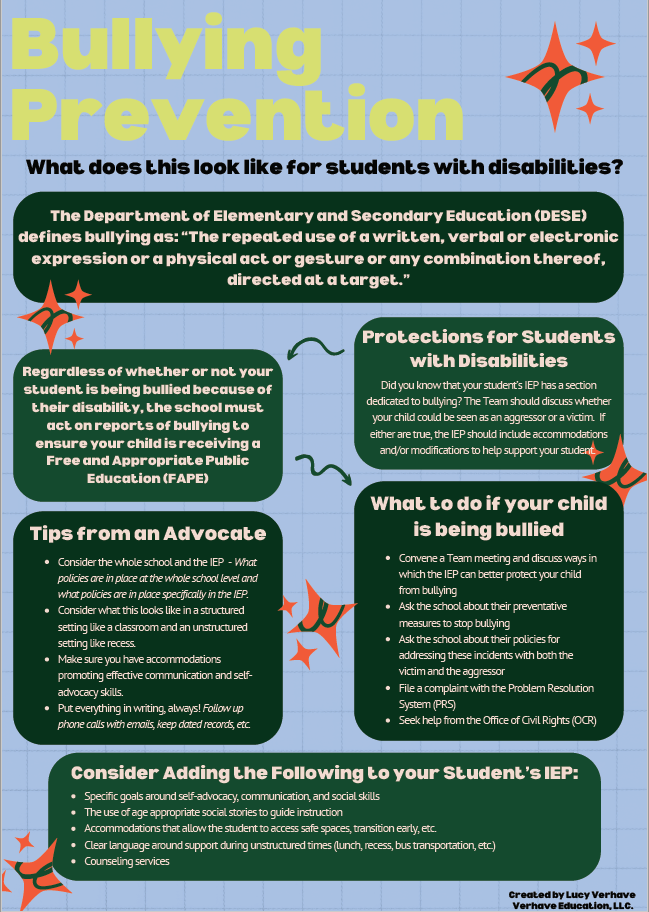
What does bullying look like for students with disabilities?
The Massachusetts Department of Elementary and Secondary Education (DESE) defines bullying as:
The repeated use of a written, verbal or electronic expression or physical act or gesture of any combination thereof, directed at a target.
For students with disabilities, bullying may show up as:
- Teasing or name‑calling about a student’s disability, learning needs, or behavior
- Exclusion from groups or activities
- Online harassment or group chats targeting the student
- Physical or verbal aggression in less structured settings (hallways, buses, recess, lunch)
Regardless of whether or not your student is being bullied because of their disability, the school must act on reports of bullying to ensure your child is receiving a Free and Appropriate Public Education (FAPE).
Protections for students with disabilities
If your child has an IEP or 504 plan, bullying should be considered in the context of their disability and educational needs.
Families can:
- Ask that the IEP or 504 team discuss whether bullying is affecting your child’s access to learning and participation in school.
- Request that the team consider accommodations, supports, or services that increase safety and inclusion.
- Ask how the school’s bullying prevention policies are being applied to your child’s situation.
- Request copies of relevant policies and procedures (e.g., the district’s bullying prevention and intervention plan).
If bullying is happening because of your child’s disability, the school still must act on reports and ensure your child continues to receive FAPE.
What to do if your child is being bullied
If you learn or suspect that your child is being bullied, you may want to:
- Request a Team/504 meeting.
- Talk with the Team about how bullying is affecting your child.
- Discuss ways the IEP or 504 plan can better protect and support your child.
- Tell school staff and document concerns.
- Notify the classroom teacher, counselor, and principal.
- Keep a written log of incidents (dates, times, locations, who was involved).
- Ask what prevention steps are being taken.
- How is the school addressing behavior with both the target and the aggressor?
- What supervision or safety measures are in place?
- Use the district’s formal reporting process.
- File the school or district bullying/harassment report form, if available.
- Seek additional support if needed.
- Talk with your pediatrician, therapist, or counselor.
- Consider contacting the Office for Civil Rights (OCR) or other advocacy organizations if you believe your child’s civil rights are being violated.
How to report bullying at WPS
Students, parents or guardians, and others, who witness or become aware of an instance of bullying or retaliation involving a student, should report it to the Principal or Superintendent (when the Principal or Assistant Principal is the alleged aggressor).
Under WPS policy, reports may be made anonymously, but no disciplinary action will be taken against an alleged aggressor solely on the basis of an anonymous report.
Students, parents or guardians, and others may request assistance from a staff member to complete a written report. WPS policy requires students be provided practical, safe, private and age-appropriate ways to report and discuss an incident of bullying with a staff member, or with the Principal or Superintendent.
Tips from an Advocate
Some questions and steps an advocate might suggest:
- Review the school‑wide plan and your child’s IEP.
What policies are in place?
Is bullying or peer interaction addressed anywhere in the IEP?
- Look at when and where bullying happens.
- What does it look like in structured settings (classrooms)
- What does it look like in less structured times (recess, lunch, bus, transitions)?
- Strengthen communication.
- Ask how staff will communicate with you when incidents occur.
- Consider using a simple communication log between home and school.
- Support your child’s self‑advocacy.
- Practice words or scripts your child can use to ask for help.
- Identify adults at school your child feels safe going to.
Consider Adding the Following to Your Student's IEP:
Depending on your child’s needs, you can ask the Team to consider:
Goals
- Self‑advocacy and self‑determination skills
- Social skills, communication, and relationship‑building
- Emotional regulation and coping strategies
Accommodations / supports
- Check‑ins with a trusted adult during the day
- Clear, consistent adult supervision in identified hot spots
- Safe spaces or designated adults your child can go to when feeling unsafe
- Adjustments to seating, group work, or transitions to reduce risk
Services
- Social skills groups or counseling services
- Direct instruction in problem‑solving and conflict resolution
- Support during unstructured times (e.g., lunch, recess, bus, transitions)
Need help thinking this through?
If you're dealing with bullying and aren't sure where to start:
Wellesley SEPAC volunteers can’t provide legal advice, but we can listen, share information about options, and connect you with organizations that may help.